Ceres Solver Tutorial
1 Installation
2 Tutorial
Hello World!
求取函数最小值:
\[\frac{1}{2}(10 -x)^2.\]
struct CostFunctor
{
    template <typename T>
    bool operator()(const T* const x, T* residual) const
    {
        residual[0] = T(10.0) - x[0];
        return true;
    }
};
// f(x) = 10 - x
void HelloWorld::RunDemo()
{
    // The variable to solve for with its initial value. It will be
    // mutated in place by the solver.
    double x = 0.5;
    const double initial_x = x;

    // Build the problem.
    ::ceres::Problem problem;


    // Set up the only cost function (also known as residual). This uses
    // auto-differentiation to obtain the derivative (jacobian).
    ::ceres::CostFunction* cost_function =
            new ::ceres::AutoDiffCostFunction<CostFunctor, 1, 1>(new CostFunctor);
    problem.AddResidualBlock(cost_function, nullptr, &x);

    // Run the solver!
    ::ceres::Solver::Options options;
    options.minimizer_progress_to_stdout = true;
    ::ceres::Solver::Summary summary;
    Solve(options, &problem, &summary);
    std::cout << summary.BriefReport() << "\n";
    std::cout << "x : " << initial_x << " -> " << x << "\n";
}
iter      cost      cost_change  |gradient|   |step|    tr_ratio  tr_radius  ls_iter  iter_time  total_time
  0  4.512500e+01    0.00e+00    9.50e+00   0.00e+00   0.00e+00  1.00e+04       0    5.33e-04    3.46e-03
  1  4.511598e-07    4.51e+01    9.50e-04   9.50e+00   1.00e+00  3.00e+04       1    5.00e-04    4.05e-03
  2  5.012552e-16    4.51e-07    3.17e-08   9.50e-04   1.00e+00  9.00e+04       1    1.60e-05    4.09e-03
Ceres Solver Report: Iterations: 2, Initial cost: 4.512500e+01, Final cost: 5.012552e-16, Termination: CONVERGENCE
x : 0.5 -> 10
Footnotes
Curve Fitting
曲线函数 :
\[y = e^{mx + c}.\]
struct ExponentialResidual
{
public:
    ExponentialResidual(double x, double y)
        : x_(x), y_(y) {}

    template <typename T>
    bool operator()(const T* const m, const T* const c, T* residual) const
    {
        residual[0] = T(y_) - exp(m[0] * T(x_) + c[0]);
        return true;
    }

private:
    // Observations for a sample.
    const double x_;
    const double y_;
};
void CurveFitting::RunDemo()
{
    double m = 0.0;
    double c = 0.0;
    ::ceres::Problem problem;
    for (int i = 0; i < kNumObservations; ++i)
    {
        problem.AddResidualBlock(
                new ::ceres::AutoDiffCostFunction<ExponentialResidual, 1, 1, 1>(
                        new ExponentialResidual(data[2 * i], data[2 * i + 1])),
                NULL,
                &m,
                &c);
    }

    ::ceres::Solver::Options options;
    options.max_num_iterations = 25;
    // QR Ax= b
    options.linear_solver_type = ::ceres::DENSE_QR;
    options.minimizer_progress_to_stdout = true;

    // Result
    ::ceres::Solver::Summary summary;
    ::ceres::Solve(options, &problem, &summary);
    std::cout << summary.BriefReport() << "\n";
    std::cout << "Initial m: " << 0.0 << " c: " << 0.0 << "\n";
    std::cout << "Final   m: " << m << " c: " << c << "\n";
}
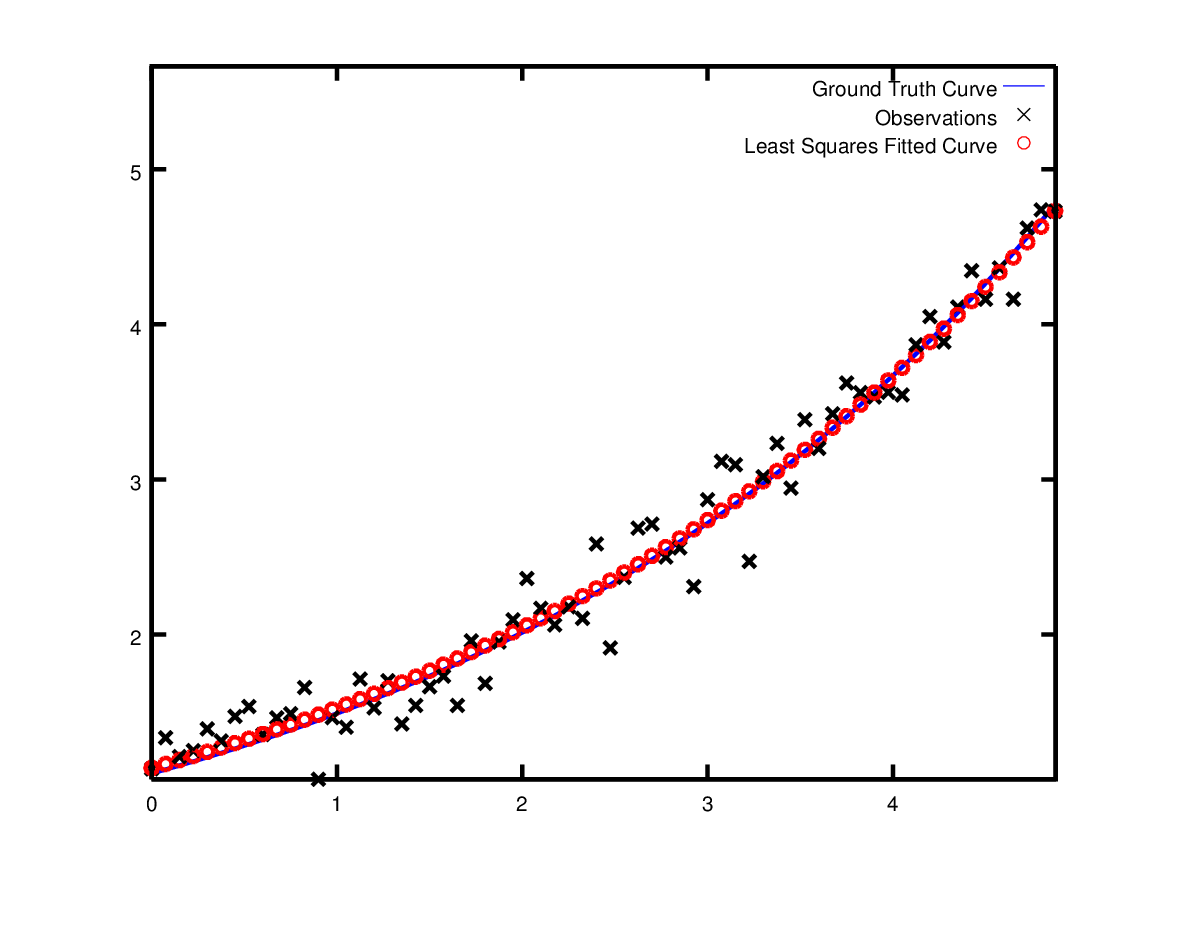
Least squares curve fitting.
Footnotes