MSCKF

1 介绍

编译安装

# 安装依赖
sudo apt-get install libsuitesparse-dev

cd your_work_space
catkin_make --pkg msckf_vio --cmake-args -DCMAKE_BUILD_TYPE=Release

运行

  • 下载 EuRoC or the UPenn fast flight dataset

# EuRoC
roslaunch msckf_vio msckf_vio_euroc.launch

# UPenn fast flight
roslaunch msckf_vio msckf_vio_fla.launch

# rosbag
rosbag play V1_01_easy.bag

# RVIZ
rosrun rviz rosrun

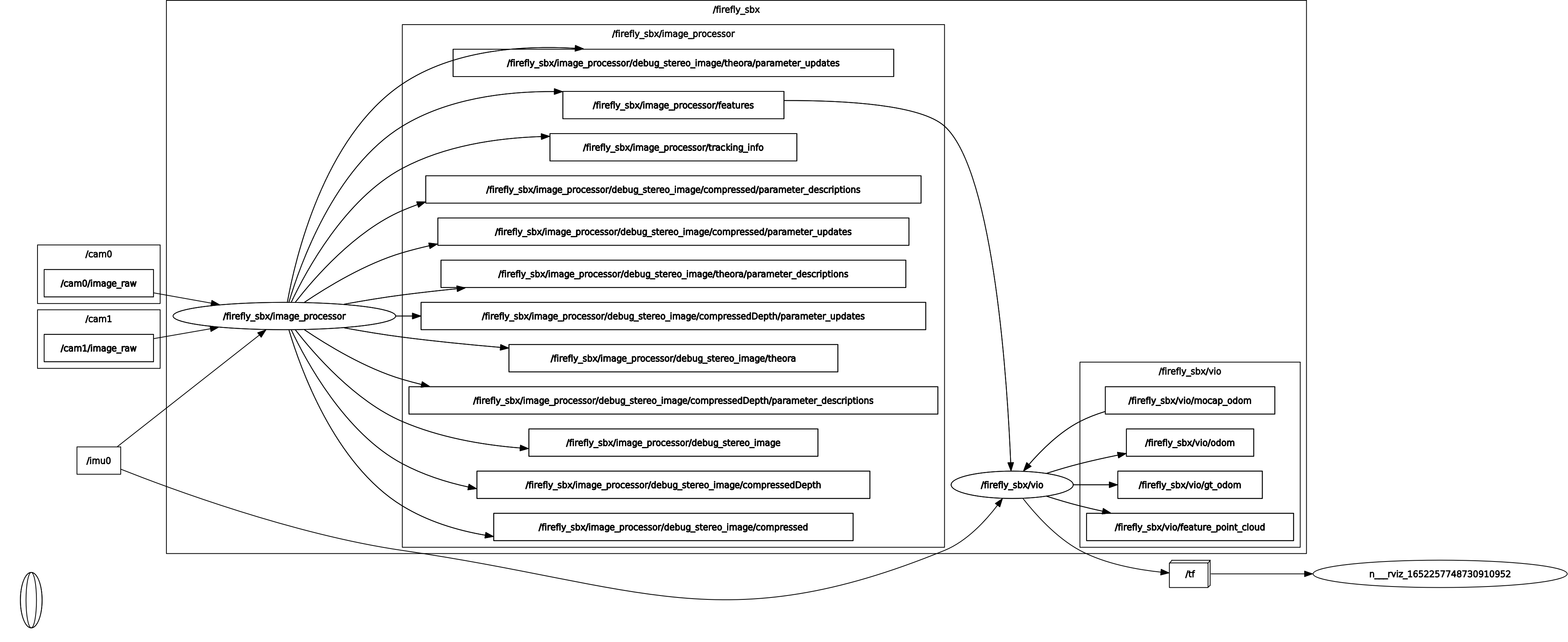
MSCKF的ros graph
../_images/msckf_vio.png

视频结果

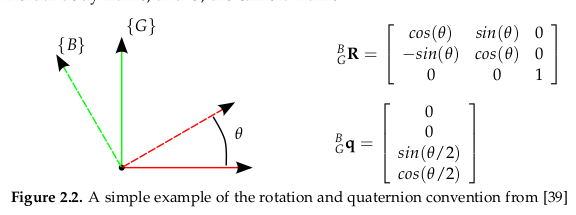
2 符号表示

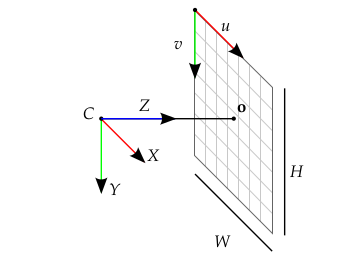
../_images/coordinate_frames.png
  • G : 世界坐标系

  • C : 相机坐标系

  • B : 机体坐标系

3 概率状态估计

概率论基础

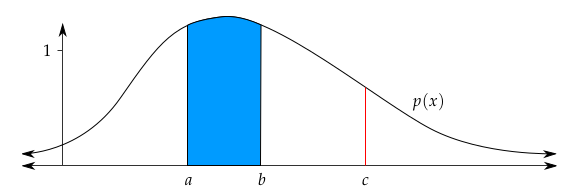
\(P(x = X)\) 在某个范围内的概率等于 概率密度函数 \(p(x)\) 在该范围内的积分
../_images/probability_density_function.png

均值和方差

  • \(\mathbb{E}(x) = \int x p(x) dx\)

  • \(Var(x) = \mathbb{E}[x - \mathbb{E}(x)^2] = \sigma^2\)

高斯分布

一维高斯密度函数
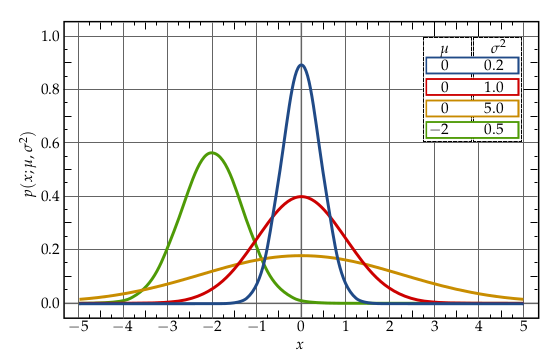
\[p(x; \mu, \sigma) = \frac{1}{\sqrt{2 \pi \sigma^2}} exp \left\{ -\frac{(x- \mu)^2}{2\sigma^2} \right\}\]
../_images/normal_distribution.png

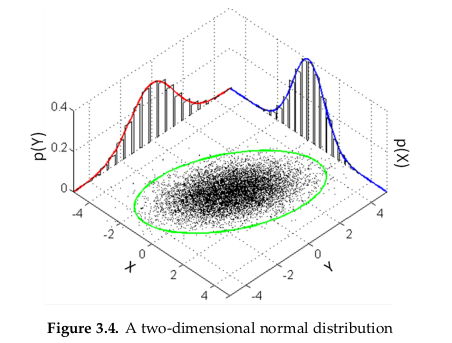
\(N\) 维高斯密度函数

\[p(\mathbf{x}; \mathbf{\mu}, \mathbf{\Sigma}) = \frac{1}{\sqrt{(2\pi)^2|\mathbf{\Sigma}|}} exp \left\{ -\frac{1}{2} (\mathbf{x}- \mathbf{\mu})^T\Sigma^{-1}(\mathbf{x}- \mathbf{\mu}) \right\}\]

其中:

\[\begin{split}\begin{aligned} Cov(\mathbf{x}, \mathbf{y}) &= \mathbb{E[(\mathbf{x} - \mathbb{E(x)})(\mathbf{y} - \mathbb{E(y)})]} \\ Cov\left(\begin{bmatrix} x_1 \\ x_2 \\ \vdots \\ x_n \end{bmatrix} \right) &= \begin{bmatrix} \sigma_{x_1}^2 & \rho_{(x_1, x_2)}\sigma_{x_1}\sigma_{x_2} & \dots & \rho_{(x_1, x_n)}\sigma_{x_1}\sigma_{x_n} \\ \rho_{(x_2, x_1)}\sigma_{x_2}\sigma_{x_1} & \sigma_{x_2}^2 & \dots & \rho_{(x_2, x_n)}\sigma_{x_2}\sigma_{x_n} \\ \vdots & \vdots & \ddots & \vdots \\ \rho_{(x_n, x_1)}\sigma_{x_n}\sigma_{x_1} & \rho_{(x_n, x_2)}\sigma_{x_n}\sigma_{x_2} & \dots & \sigma_{x_n}^2 \end{bmatrix} \end{aligned}\end{split}\]
../_images/two-dimensional_normal_distribution.png

条件高斯

\[\begin{split}\begin{bmatrix} \mathbf{x} \\ \mathbf{y} \end{bmatrix} = N(\mathbf{\mu}, \mathbf{\Sigma}) = \left( \begin{bmatrix} \mu_x \\ \mu_y \end{bmatrix}, \begin{bmatrix} \Sigma_{xx} & \Sigma_{xy} \\ \Sigma_{yx} & \Sigma_{yy} \end{bmatrix} \right)\end{split}\]

边缘化

\[p(x) = \int p(x,y) dy = \int p(x|y) p(y)dy = N(\mu_x, \Sigma_{xx})\]

条件概率

\[\begin{split}p\left( \begin{bmatrix} x \\ y \end{bmatrix} \right) = N\left( \begin{bmatrix} \mu_x \\ \mu_y \end{bmatrix}, \begin{bmatrix} \Sigma_{xx} & \Sigma_{xy} \\ \Sigma_{yx} & \Sigma_{yy} \end{bmatrix} \right) = N\left( \begin{bmatrix} \mu_x \\ A\mu_x + b \end{bmatrix}, \begin{bmatrix} \Sigma_{xx} & \Sigma_{xx}A^T \\ A\Sigma_{xx} & A\Sigma_{xx}A^T + Q \end{bmatrix} \right)\end{split}\]

其中:

  • \(\mathbf{x} \sim N(\mu_x, \Sigma_{xx})\)

  • \(y = Ax + b, \quad b \sim N(0, Q)\)

4 卡尔曼滤波

4.1 卡尔曼滤波

初始状态估计

\[\mathbf{x_0} \sim N(\hat{\mathbf{x}}_{0|0}, \mathbf{\Sigma}_{0|0})\]

预测

\[\begin{split}\mathbf{Given}: \mathbf{x}_{t+1} = \mathbf{A}_{t}\mathbf{x}_{t} + \mathbf{B}_{t}\mathbf{u}_{t} + \mathbf{\epsilon}_{t} \quad \mathbf{\epsilon}_{t} \sim N(\mathbf{0}, \mathbf{Q}_t) \\ \begin{aligned} \hat{\mathbf{x}}_{t+1|t} &= \mathbf{A}_{t|t}\hat{\mathbf{x}}_{t} + \mathbf{B}_{t}\mathbf{u}_{t} \\ \hat{\mathbf{\Sigma}}_{t+1|t} &= \mathbf{A}_{t}\hat{\mathbf{\Sigma}}_{t}\mathbf{A}_{t}^T + \mathbf{Q}_{t} \end{aligned}\end{split}\]

更新

\[\begin{split}\mathbf{Given}: \mathbf{x}_{t} = \mathbf{C}_{t}\mathbf{x}_{t} + \mathbf{\epsilon}_{t} \quad \mathbf{\delta}_{t} \sim N(\mathbf{0}, \mathbf{R}_t) \\ \begin{aligned} \hat{\mathbf{x}}_{t|t} &= \hat{\mathbf{x}}_{t|t-1} + \mathbf{K}_{t}(\mathbf{z}_t - C_t\hat{\mathbf{x}}_{t|t-1}) \\ \mathbf{\Sigma}_{t|t} &= \mathbf{\Sigma}_{t|t-1} - K_t C_t \mathbf{\Sigma}_{t|t-1} \\ \mathbf{K}_{t} &= \mathbf{\Sigma}_{t|t-1}C_t^T(C_t\mathbf{\Sigma}_{t|t-1}C_t^T + R_t)^{-1} \end{aligned}\end{split}\]

4.2 扩展卡尔曼滤波EKF

4.3 卡尔曼滤波Python例子

二次函数添加噪点,二次函数

\[y = -x^{2} - 2x + 2\]

Python例子

import numpy as np

class KalmanFilter(object):
    def __init__(self, F = None, B = None, H = None, Q = None, R = None, P = None, x0 = None):

        if(F is None or H is None):
            raise ValueError("Set proper system dynamics.")

        self.n = F.shape[1]
        self.m = H.shape[1]

        self.F = F
        self.H = H
        self.B = 0 if B is None else B
        self.Q = np.eye(self.n) if Q is None else Q
        self.R = np.eye(self.n) if R is None else R
        self.P = np.eye(self.n) if P is None else P
        self.x = np.zeros((self.n, 1)) if x0 is None else x0

    def predict(self, u = 0):
        self.x = np.dot(self.F, self.x) + np.dot(self.B, u)
        self.P = np.dot(np.dot(self.F, self.P), self.F.T) + self.Q
        return self.x

    def update(self, z):
        y = z - np.dot(self.H, self.x)
        S = self.R + np.dot(self.H, np.dot(self.P, self.H.T))
        K = np.dot(np.dot(self.P, self.H.T), np.linalg.inv(S))
        self.x = self.x + np.dot(K, y)
        I = np.eye(self.n)
        self.P = np.dot(np.dot(I - np.dot(K, self.H), self.P),
          (I - np.dot(K, self.H)).T) + np.dot(np.dot(K, self.R), K.T)

def example():
  dt = 1.0/60
  F = np.array([[1, dt, 0], [0, 1, dt], [0, 0, 1]])
  H = np.array([1, 0, 0]).reshape(1, 3)
  Q = np.array([[0.05, 0.05, 0.0], [0.05, 0.05, 0.0], [0.0, 0.0, 0.0]])
  R = np.array([0.5]).reshape(1, 1)

  x = np.linspace(-10, 10, 100)
  ground_truths = -x**2 - 2*x + 2
  measurements = -(x**2 + 2*x - 2) + np.random.normal(0, 2, 100)

  kf = KalmanFilter(F = F, H = H, Q = Q, R = R)
  predictions = []

  for z in measurements:
    predictions.append(np.dot(H,  kf.predict())[0])
    kf.update(z)

  import matplotlib.pyplot as plt
  plt.plot(range(len(ground_truths)), ground_truths, label = 'GroundTruth')
  plt.plot(range(len(measurements)), measurements, label = 'Measurements')
  plt.plot(range(len(predictions)), np.array(predictions), label = 'Kalman Filter Prediction')
  plt.legend()
  plt.show()

if __name__ == '__main__':
    example()

kalman filter结果
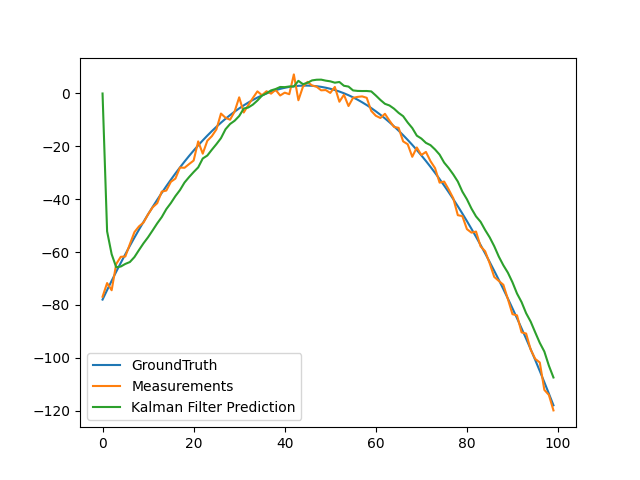
../_images/python_kalman_filter_demo.png

5 IMU

5.1 Accelerometers(加速计)

\[^B \mathbf{a}_m = \mathbf{T}_a {_G^B}\mathbf{R}(^G\mathbf{a} - ^G\mathbf{g}) + \mathbf{n}_a + \mathbf{b}_a\]

其中:

  • \(\mathbf{T}_a\) : 加速度计测量中导致未对准和比例误差的矩阵系数

  • \(^G\mathbf{a}\) : 全局坐标系中 IMU 的真实加速度,{ B } 表示惯性体(IMU)坐标系。

  • \(^G\mathbf{g}: \quad \mathbf{g} = (0, 0, -1)^T\)

  • \(\mathbf{n}_a \sim N(0, N_a)\)

  • \(\mathbf{b}_a:\) 随时间变化,建模为随机游走过程噪声 \(n_{wa} \sim N(0,N_{wa} )\)

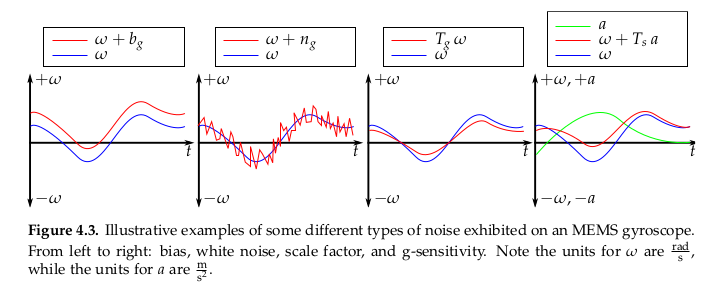
5.2 Gyroscope(陀螺仪)

../_images/gyroscope.png
\[^B \mathbf{\omega}_m = \mathbf{T}_g \omega +\mathbf{T}_s ^B\mathbf{a} + \mathbf{n}_g + \mathbf{b}_g\]

其中:

  • \(\mathbf{n}_g \sim N(0, N_g)\)

  • \(\mathbf{b}_g:\) 随时间变化,建模为随机游走过程噪声 \(n_{wg} \sim N(0,N_{wg})\)

5.3 Noise and Bias Characteristics(噪声和零偏特性)

5.4 运动模型

状态向量:

\[\mathbf{X} = \begin{bmatrix} _G^I\mathbf{q}(t)^T, \mathbf{b}_g(t)^T, ^G\mathbf{v}_I(t)^T, \mathbf{b}_a(t)^T, ^G\mathbf{p}_I(t)^T, _C^I\mathbf{q}(t)^T, ^I{\mathbf{p}(t)_C}^T \end{bmatrix}\]
  • \(_G^I\mathbf{q}(t)^T\) : 代表惯性系到IMU坐标系的旋转

  • \(\mathbf{b}_g(t)^T\) : 表示在IMU坐标系中测量值线加速度的biases

  • \(^G\mathbf{v}_I(t)^T\) : 代表IMU坐标系在惯性系中的速度

  • \(\mathbf{b}_a(t)^T\) : 表示在IMU坐标系中测量值角速度的biases

  • \(^G\mathbf{p}_I(t)^T\) : 代表IMU坐标系在惯性系中的位置

  • \(C^I\mathbf{q}(t)^T\) : 表示相机坐标系和IMU坐标系的相对位置,其中相机坐标系取左相机坐标系。

  • \(^I{\mathbf{p}(t)_C}^T\) : 表示相机坐标系和IMU坐标系的相对位置,其中相机坐标系取左相机坐标系。

  • \(\mathbf{w}(t)^T = [w_x(t), w_y(t), w_z(t)]^T\) : 是IMU角速度在IMU系中的坐标

IMU的观测值为

\[\begin{split}\begin{aligned} \mathbf{\omega}_m &= \mathbf{\omega} + C(_G^I\mathbf{q}) \mathbf{\omega}_G + \mathbf{b}_g + \mathbf{n}_g \\ \mathbf{a}_m &= C(_G^I\mathbf{q}) (^G\mathbf{a}_I - ^G\mathbf{g} + 2 \mathbf{{\omega}_G}_{\times} ^G\mathbf{v}_I + {{\omega}_G}_{\times}^2(^G\mathbf{p}_I)) + \mathbf{b}_a + \mathbf{n}_a \end{aligned}\end{split}\]
  • 将地球自转的影响忽略不计

  • 其中 \(w_{G}\) 为地球的自转速度在 \(G\) 系的坐标

\[\tilde{\mathbf{X}}_{IMU} = \mathbf{F} \tilde{{X}}_{IMU} + \mathbf{G} \mathbf{n}_{IMU}\]

矩阵形式

\[\begin{split}\begin{aligned} \underbrace{ \begin{bmatrix} \dot{\delta{\theta}}_{I} \\ \dot{\tilde{b}}_{g} \\ ^{G}\dot{\tilde{v}}_{I} \\ \dot{\tilde{b}}_{a} \\ ^{G}\dot{\tilde{p}}_{I} \end{bmatrix} }_{\dot{\tilde{\mathbf{X}}}_{IMU}} = \underbrace { \begin{bmatrix} -\mathbf{[w]}_{\times} & -\mathbf{I}_{3} & \mathbf{0}_{3 \times 3} & \mathbf{0}_{3 \times 3} & \mathbf{0}_{3 \times 3} \\ \mathbf{0}_{3 \times 3} & \mathbf{0}_{3 \times 3} & \mathbf{0}_{3 \times 3} & \mathbf{0}_{3 \times 3} & \mathbf{0}_{3 \times 3} \\ -C (^I_G\hat{\mathbf{q}})^{T}\mathbf{[\hat{a}_{\times}]} & \mathbf{0}_{3 \times 3} & \mathbf{0}_{3 \times 3} & -C (^I_G\hat{\mathbf{q}})^{T} & \mathbf{0}_{3 \times 3} \\ \mathbf{0}_{3 \times 3} & \mathbf{0}_{3 \times 3} & \mathbf{0}_{3 \times 3} & \mathbf{0}_{3 \times 3} & \mathbf{0}_{3 \times 3} \\ \mathbf{0}_{3 \times 3} & \mathbf{0}_{3 \times 3} & \mathbf{I}_{3} & \mathbf{0}_{3 \times 3} & \mathbf{0}_{3 \times 3} \end{bmatrix} }_{F} \underbrace{ \begin{bmatrix} \delta{\theta}_{I} \\ \tilde{b}_{g} \\ ^{G}\tilde{v}_{I} \\ \tilde{b}_{a} \\ ^{G}\tilde{p}_{I} \end{bmatrix} }_{\tilde{\mathbf{X}}_{IMU}} \\ + \underbrace{ \begin{bmatrix} -\mathbf{I}_{3} & \mathbf{0}_{3 \times 3} & \mathbf{0}_{3 \times 3} & \mathbf{0}_{3 \times 3} \\ \mathbf{0}_{3 \times 3} & \mathbf{I}_{3 } & \mathbf{0}_{3 \times 3} & \mathbf{0}_{3 \times 3} \\ \mathbf{0}_{3 \times 3} & \mathbf{0}_{3 \times 3} & -C (^I_G\hat{\mathbf{q}})^{T} & \mathbf{0}_{3 \times 3} \\ \mathbf{0}_{3 \times 3} & \mathbf{0}_{3 \times 3} & \mathbf{0}_{3 \times 3} & \mathbf{I}_{3 } \\ \mathbf{0}_{3 \times 3} & \mathbf{0}_{3 \times 3} & \mathbf{0}_{3 \times 3} & \mathbf{0}_{3 \times 3} \end{bmatrix} }_{G} \underbrace{ \begin{bmatrix} \mathbf{n}_g \\ \mathbf{n}_{wg} \\ \mathbf{n}_a \\ \mathbf{n}_{wa} \end{bmatrix} }_{\mathbf{n}_{IMU}} \end{aligned}\end{split}\]

5.5 状态转移矩阵

\[\dot{\mathbf{\Phi}}(t_k + \tau, t_k) = \mathbf{F}\mathbf{\Phi}(t_k + \tau, t_k)\]

性质:

  • \(\mathbf{\Phi}(t_k, t_k) = \mathbf{I}_{15 \times 15}\)

  • \(\mathbf{\Phi} \approx I + F \Delta {t}\)

因此:

\[\tilde{\mathbf{X}}_{k+1} = \mathbf{\Phi}(t_k + T, t_k) \tilde{\mathbf{X}}_{k}\]

5.6 四阶Runge-Kutta积分

ODE方程:

\[y\prime = f(x, y), y(x_0) = y_0, x_0 \le x \le x_n\]

so that:

\[\begin{split}\begin{aligned} y_{i+1} &= y_i + \frac{1}{6} h (k_1 + 2k_2 + 2k_3 + k_4) \\ k_1 &= f(x_i, y_i) \\ k_2 &= f(x_i + \frac{1}{2}h, y_i + \frac{1}{2} k_1 h) \\ k_3 &= f(x_i + \frac{1}{2}h, y_i + \frac{1}{2} k_2 h) \\ k_4 &= f(x_i + h, y_i + k_3 h) \end{aligned}\end{split}\]

\[2 y\prime + y = e^{-x}, y(0) = \frac{1}{2}, 0 \le x \le 2\]
% 输入参数
fun = @(x, y) (exp(-x) - y) / 2;
x = 0 : 0.1 : 2;
y0 = 1/2;
% 调用RK4函数求解
y = RK4(fun, x, y0);
% 设置图幅
fig = gcf;
fig.Color = 'w';
fig.Position = [250, 250, 960, 540];
% 绘制数值解
p = plot(x, y);
p.LineStyle = 'none';
p.Marker = 'p';
p.MarkerEdgeColor = 'r';
p.MarkerFaceColor = 'b';
p.MarkerSize = 8;
hold on, grid on
% 求解符号解
syms y(x)
equ = 2 * diff(y, x) == exp(-x) - y;
cond = y(0) == 1/2;
y = dsolve(equ, cond);
% 绘制符号解
fplot(y, [0, 2])
% 设置信息
xlabel('x', 'fontsize', 12);
ylabel('y', 'fontsize', 12);
title('RK4求解ODE', 'fontsize', 14);
legend({'数值解', '符号解'}, 'fontsize', 12);

RK4函数如下

function y = RK4(fun, x, y0)

  %RK4 使用经典的RK4方法求解一阶常微分方程。
  % fun是匿名函数。
  % x是迭代区间
  % y0迭代初始值。

  y = 0 * x;
  y(1) = y0;
  h = x(2) - x(1);
  n = length(x);

  for m = 1 : n-1
      k1 = fun(x(m), y(m));
      k2 = fun(x(m)+h/2, y(m)+h*k1/2);
      k3 = fun(x(m)+h/2, y(m)+h*k2/2);
      k4 = fun(x(m)+h, y(m)+h*k3);
      y(m+1) = y(m) + h*(k1 + 2*k2 + 2*k3 + k4) / 6;
  end
end

求解如下:
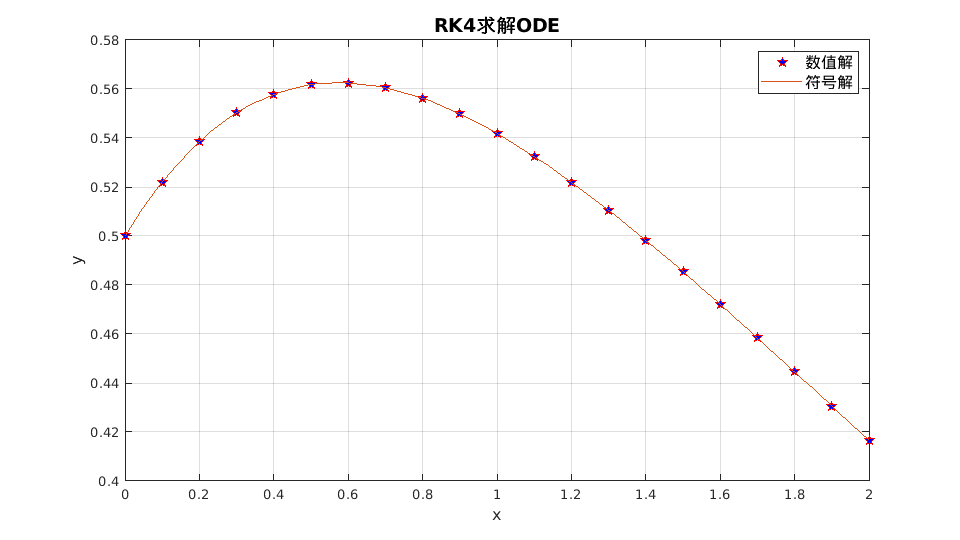
../_images/rk4.png

6 计算机视觉

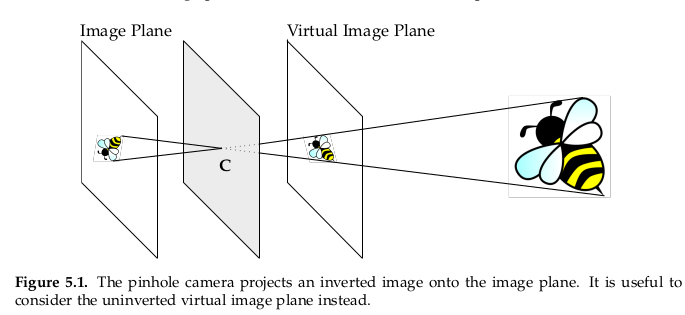
6.1 Pinhole Camera Model(针孔模型)

../_images/pinhole_camera_model.png

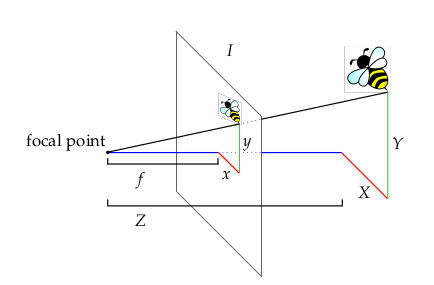
6.2 相机投影

../_images/camera_projection.png

投影变换

\[\begin{split}\begin{aligned} x = f_x \frac{X}{Z} + c_x \\ y = f_y \frac{Y}{Z} + c_y \end{aligned}\end{split}\]
../_images/camera_and_pixel_coordinate_frames.png

6.3 图像畸变

\[\begin{split}\begin{aligned} \mathbf{h} \begin{pmatrix} X \\ Y \\ Z \end{pmatrix} &= \begin{bmatrix} f_x & 0 \\ 0 & f_y \end{bmatrix} \begin{pmatrix} d_r \begin{bmatrix} u \\ v \end{bmatrix} + d_t \end{pmatrix} + \begin{bmatrix} c_x \\ c_y \end{bmatrix} \\ d_r &= (1 + k_1r + k_2r^2 + k_3r^3) \\ d_t &= \begin{bmatrix} 2uvt_1 + (r+2u^2)t_2 \\ 2uvt_2 + (r+2v^2)t_1 \end{bmatrix} \\ with \quad u &= \frac{X}{Z}, v = \frac{Y}{Z}, r = u^2 + v^2 \end{aligned}\end{split}\]

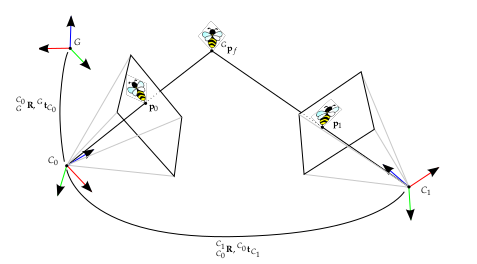
6.4 Triangulation(三角化)

../_images/triangulation.png

\(C_0\) 帧是第一次观察到该点的相机帧,该点在第 \(i\) 个相机 \(C_i\) 帧中的位置如下。

\[\begin{split}\begin{aligned} ^{C_i}\mathbf{p}_f &= _{C_0}^{C_i}\mathbf{R}(^{C_0}\mathbf{p}_f - ^{C_0}\mathbf{p}_{C_{i}}) \\ ^{C_i}\mathbf{p}_f &= _{C_0}^{C_i}\mathbf{R} ^{C_0}\mathbf{p}_f + ^{C_i}\mathbf{p}_{C_{0}} \end{aligned}\end{split}\]

这可以用逆深度参数化重写,以提高数值稳定性并帮助避免局部最小值

\[\begin{split}\begin{aligned} ^{C_i}\mathbf{p}_f &= _{C_0}^{C_i}\mathbf{R} ^{C_0}\mathbf{p}_f + ^{C_i}\mathbf{p}_{C_{0}} \\ & = _{C_0}^{C_i}\mathbf{R} ^{C_0} \begin{bmatrix} c_n X \\ c_n Y \\ c_n Z \end{bmatrix} + ^{C_i}\mathbf{p}_{C_{0}} \\ &= ^{C_0} Z \begin{pmatrix} _{C_0}^{C_i}\mathbf{R} \begin{bmatrix} \frac{^{C_0}X}{^{C_0}Z} \\ \frac{^{C_0}Y}{^{C_0}Z} \\ 1 \end{bmatrix} + \frac{1}{^{C_0}Z} ^{C_i} \mathbf{p}_{C_{0}} \end{pmatrix} \\ &= ^{C_0} Z \begin{pmatrix} _{C_0}^{C_i}\mathbf{R} \begin{bmatrix} \alpha \\ \beta \\ 1 \end{bmatrix} + \rho ^{C_i}\mathbf{p}_{C_{0}} \end{pmatrix} \\ &= ^{C_0} Z \mathbf{g}_i \begin{pmatrix} \alpha \\ \beta \\ \rho \end{pmatrix} \end{aligned}\end{split}\]

其中:

  • \(\alpha = \frac{^{C_0}X}{^{C_0}Z}\)

  • \(\beta = \frac{^{C_0}Y}{^{C_0}Z}$\)

  • \(\rho = \frac{1}{^{C_0}Z}\)

6.5 高斯牛顿最小化

\[\begin{split}\mathbf{f}_i(\mathbf{\theta}) = \mathbf{Z}_i - \mathbf{h}(\mathbf{g}_i(\mathbf{\theta})) \quad with: \quad \mathbf{\theta} = \begin{pmatrix} \alpha \\ \beta \\ \rho \end{pmatrix}\end{split}\]

损失函数cosnt function

\[S(\mathbf{\theta}) = \sum_{i=1}^{n} \mathbf{f}_i(\mathbf{\theta})^2\]

雅可比矩阵Jacobian

\[\mathbf{J}_{\mathbf{f}} = \frac{\partial{\mathbf{f}}}{\partial{\mathbf{\theta}}} = \frac{\partial{\mathbf{\mathbf{h}}}}{\partial{\mathbf{\mathbf{g}}}} \frac{\partial{\mathbf{\mathbf{g}}}}{\partial{\mathbf{\mathbf{\theta}}}}\]

其中:

\[\begin{split}\frac{\partial{\mathbf{\mathbf{h}}}}{\partial{\mathbf{\mathbf{g}}}} = \begin{bmatrix} f_x & 0 \\ 0 & f_y \end{bmatrix} \begin{bmatrix} \frac{d_r}{z} + \frac{\partial{d_r}}{\partial{x}}u + \frac{\partial{d_t}}{\partial{x}} & \frac{\partial{d_r}}{\partial{y}}u + \frac{\partial{d_t}}{\partial{y}} & -\frac{d_r}{z}u + \frac{\partial{d_r}}{\partial{z}}u + \frac{\partial{d_t}}{\partial{z}} \\ \frac{\partial{d_r}}{\partial{x}}v + \frac{\partial{d_t}}{\partial{y}} & \frac{d_r}{z} + \frac{\partial{d_r}}{\partial{y}}v + \frac{\partial{d_t}}{\partial{y}} & -\frac{d_r}{z}v + \frac{\partial{d_r}}{\partial{z}}v + \frac{\partial{d_t}}{\partial{z}} \end{bmatrix}\end{split}\]

参数更新

\[\mathbf{\theta}_i^{(s+1)} = \mathbf{\theta}_i^{(s)} - \left(\mathbf{J}_{\mathbf{f}}^T \mathbf{J}_{\mathbf{f}} \right)^{-1}\mathbf{J}_{\mathbf{f}}^T \mathbf{f}( \mathbf{\theta}_i^{(s)})\]

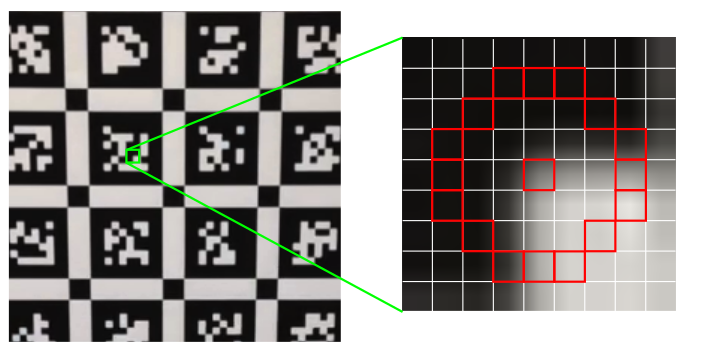
6.6 Feature Points Detect

../_images/feature_points.png

6.7 Feature Matching

7 MSCKF-VIO

EuRoC数据集

../_images/euroc_datasets.png

微型飞行器(MAV)上收集的视觉惯性数据集

  • 使用的机型为:Asctec Firefly六角旋翼直升机

  • 觉惯性测量的传感器包括:视觉(双相机)惯性测量单元(IMU)

视觉惯性传感器与groundtruth数据之间,通过外部校准使得时间戳同步。

groundtruth采集

  • Leica MS50 激光跟踪扫描仪:毫米精确定位

Note

  • LEICA0:激光追踪器配套的传感器棱镜【prism】

  • Leica Nova MS50: 激光追踪器,测量棱镜prism的位置,毫米精度,帧率20Hz,

数据集内包含的数据

  • Vicon 6D运动捕捉系统

Note

  • VICON0:维肯动作捕捉系统的配套反射标志,叫做marker

  • Vicon motion capture system: 维肯动作捕捉系统,提供在单一坐标系下的6D位姿测量,测量方式是通过在MAV上贴上一组反射标志,帧率100Hz,毫米精度

视觉惯性传感器:

Note

  • 双相机 (Aptina MT9V034型号 全局快门, 单色, 相机频率20Hz)

  • MEMS IMU (ADIS16448型号 , 测量角速度与加速度,测量频率200 Hz)(以视觉图像的时间戳为基准进行对齐)

groundtruth

Note

  • Vicon运动捕捉系统【marker】(6D姿势)

  • Leica MS50激光跟踪仪(3D位置)

  • Leica MS50 3D 结构扫描

传感器校准

Note

  • 相机内参

  • 相机-IMU外参

文件名 MH_01_easy [工厂场景]

Note

——mav0
— cam0

data :图像文件 data.csv :图像时间戳 sensor.yaml : 相机参数【内参fu,fv,cu,cv、外参T_BS(相机相对于b系的位姿)、畸变系数】

— cam1

data :图像文件 data.csv :图像时间戳 sensor.yaml : 相机参数【内参fu,fv,cu,cv、外参T_BS(相机相对于b系的位姿)、畸变系数】

— imu0

data.csv : imu测量数据【时间戳、角速度xyz、加速度xyz】 sensor.yaml : imu参数【外参T_BS、惯性传感器噪声模型以及噪声参数】

— leica0

data.csv : leica测量数据【时间戳、prism的3D位置】 sensor.yaml : imu参数【外参T_BS】

— state_groundtruth_estimae0**

data.csv :地面真实数据【时间戳、3D位置、姿态四元数、速度、ba、bg】 sensor.yaml :

在每个传感器文件夹里配一个senor.yaml文件,记录传感器相对于Body坐标系的坐标变换,以及传感器自身参数信息

groundtruth输出格式

timestamp,
p_RS_R_x [m]
p_RS_R_y [m]
p_RS_R_z [m]
q_RS_w []
q_RS_x []
q_RS_y []
q_RS_z []
v_RS_R_x [ m/s]
v_RS_R_y [ m/s]
v_RS_R_z [ m/s]
b_w_RS_S_x [rad /s]
b_w_RS_S_x [rad /s]
b_w_RS_S_z [rad /s]
b_a_RS_S_x [rad /s]
b_a_RS_S_y [rad /s]
b_a_RS_S_z [rad /s]
  • timestamp:18位的时间戳

  • position:MAV的空间3D坐标

  • p_RS_R_x [m]

  • p_RS_R_y [m]

  • p_RS_R_z [m]

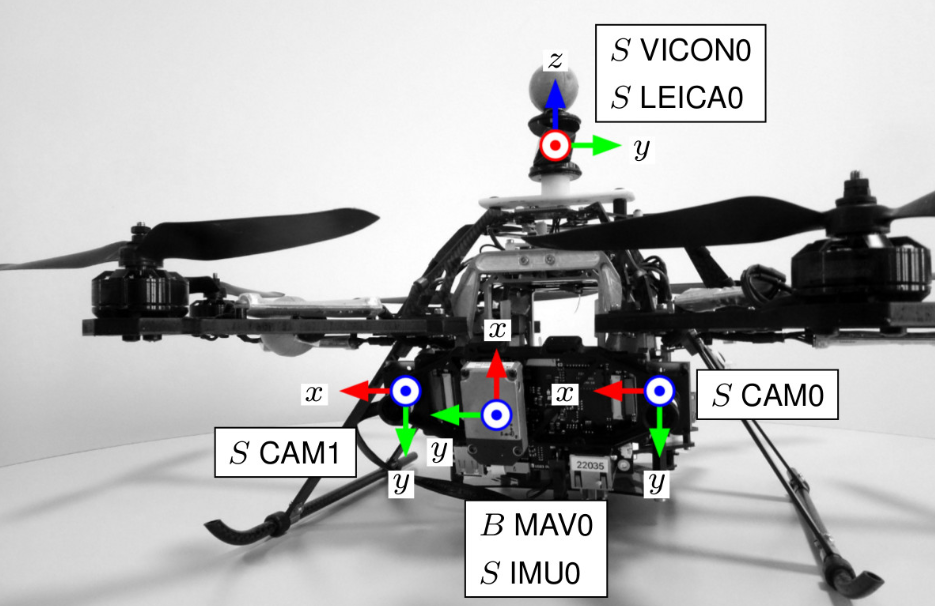
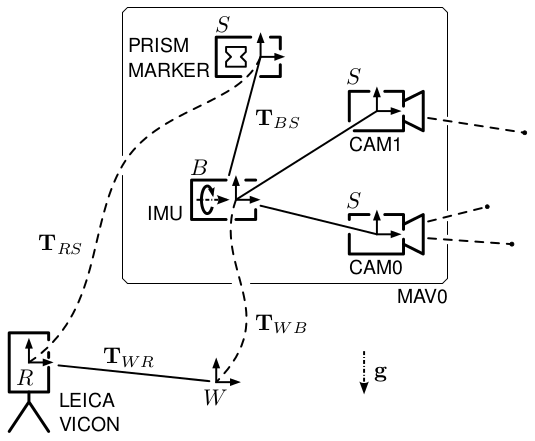
传感器安装的相对位置

../_images/sensor_setup2.png

机体上载有4个传感器,其中prism和marker公用一个坐标系 无人机的body系 以IMU传感器为基准,即,imu系为body系。

EuRoC数据集的使用

  • EuRoC数据集可用于视觉算法、视觉惯性算法的仿真测试

  • 在VIO算法中涉及到很多坐标系的转换、在精度测量过程中也需要进行统一坐标系

Note

  • 传感器数据的读取

    以相机图像与imu测量作为算法输入,首先就是要进行数据读取、将输入输出模块化

  • 建立统一坐标系

    传感器放置于统一平台上,但每个传感器都有其各自的坐标系,索性EuRoC中给出了所有传感器相对于机体body系的相对位移(sensor.yaml文件中的T_BS),因此可以将各传感器的位姿数据统一到统一坐标系下,但实际使用中需要根据代码情况灵活运用。

  • 坐标系变换:

    下标表示形式【 矩阵坐标系之间的变换矩阵的下标采用双字母进行标注】 如:旋转矩阵R_BC,表示从c系旋转到b系的变换阵

7.1 Overview

传统的EKF-SLAM框架中,特征点的信息会加入到特征向量和协方差矩阵里,这种方法的缺点是特征点的信息会给一个初始深度和初始协方差, 如果不正确的话,极容易导致后面不收敛,出现inconsistent的情况。MSCKF维护一个pose的FIFO,按照时间顺序排列, 可以称为滑动窗口,一个特征点在滑动窗口的几个位姿都被观察到的话,就会在这几个位姿间建立约束,从而进行KF的更新。 如下图所示, 左边代表的是传统EKF SLAM, 红色五角星是old feature,这个也是保存在状态向量中的,另外状态向量中只保存最新的相机姿态; 中间这张可以表示的是keyframe-based SLAM, 它会保存稀疏的关键帧和它们之间相关联的地图点; 最右边这张则可以代表MSCKF的一个基本结构, MSCKF中老的地图点和滑窗之外的相机姿态是被丢弃的, 它只存了滑窗内部的相机姿态和它们共享的地图点.
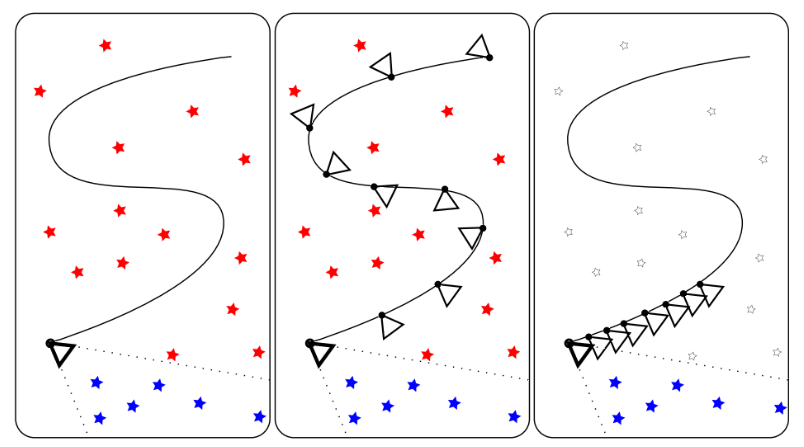
../_images/msckf_instrduction.png

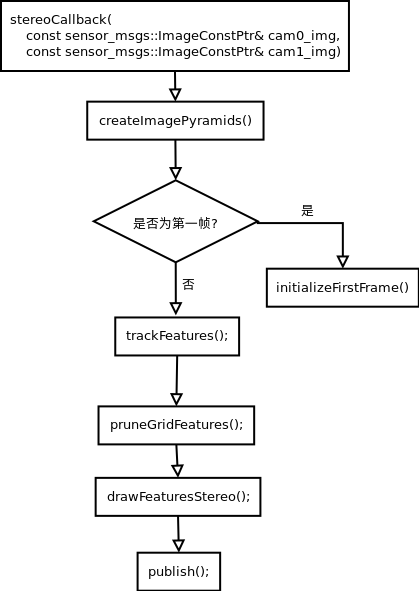
7.2 前端

跟踪流程

../_images/tracking_whole_picture.png

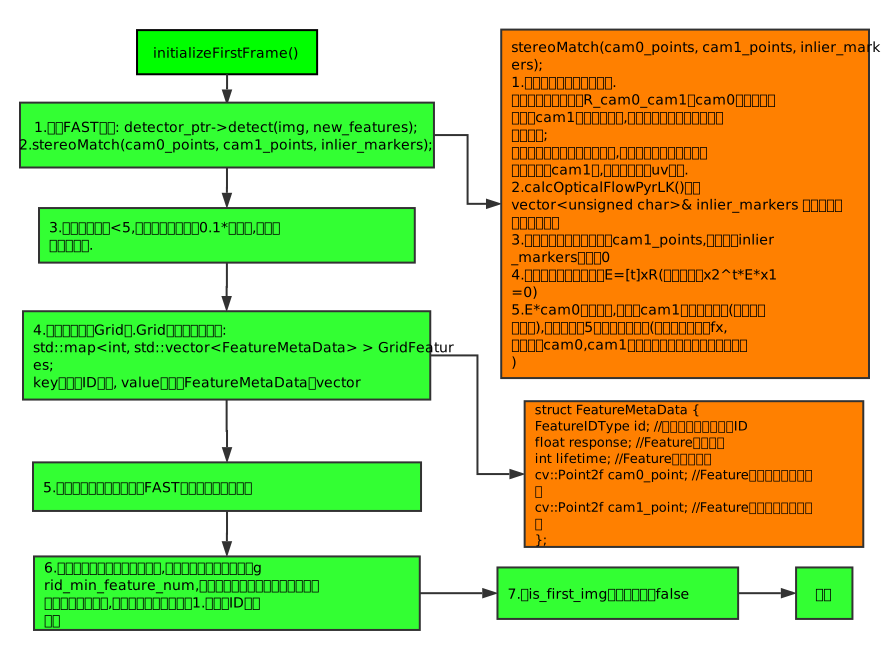
初始化Initialization

../_images/Initialization.svg

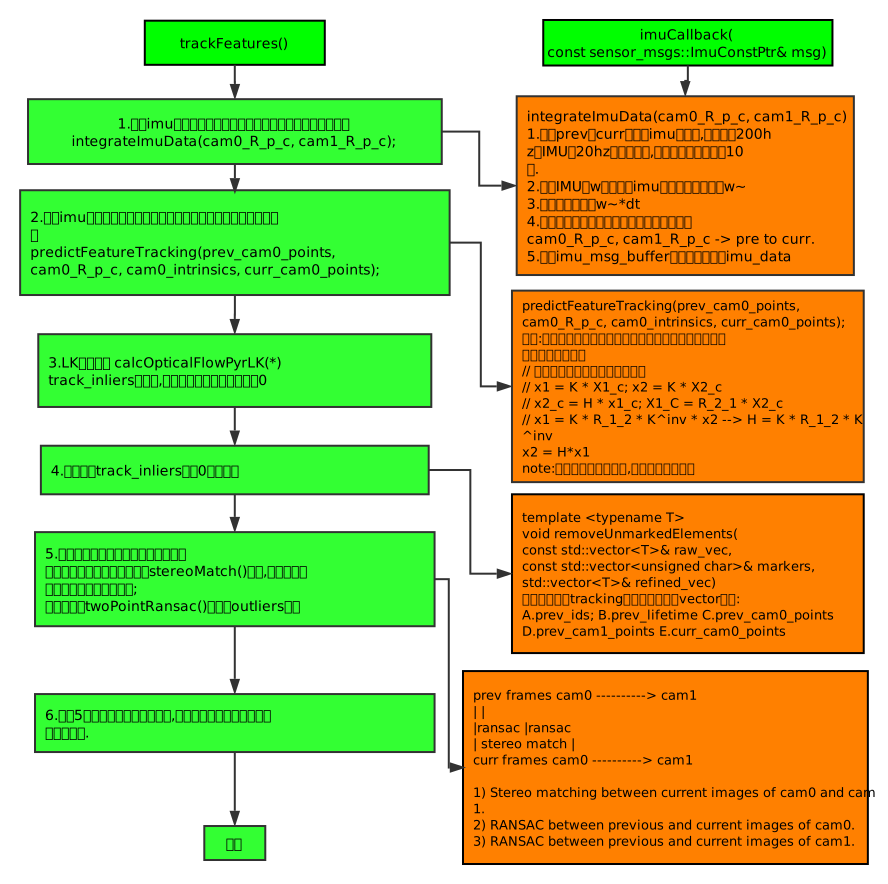
trackFeatures

../_images/trackFeatures.svg

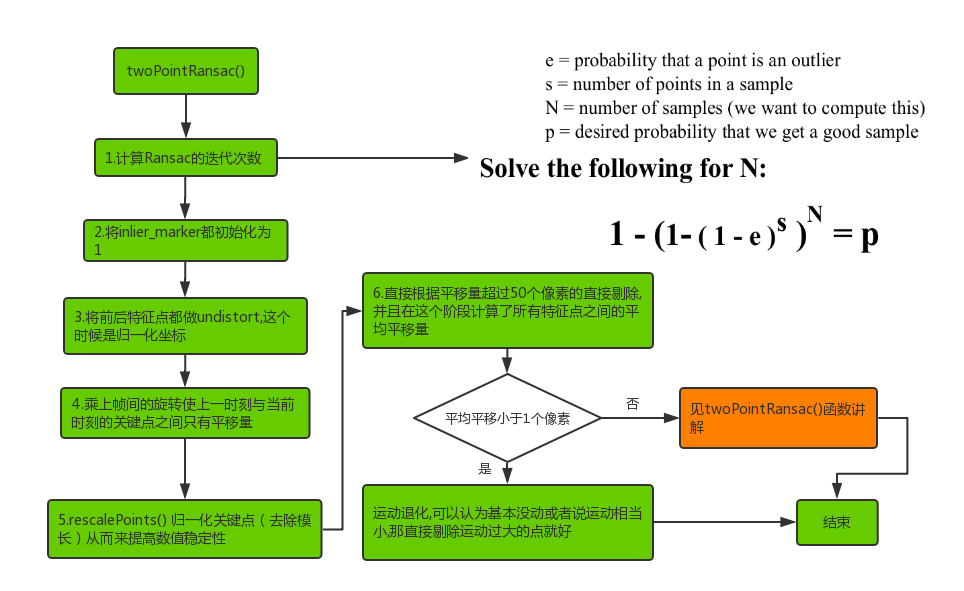
twoPointRansac

../_images/twoPointRansac.png

对极几何可约束

\[p_2^T [t]_{\times} R p_1 = 0\]
  • \(p_1 = [x_1, y_1, 1]^T\)

  • \(p_2 = [x_2, y_2, 1]^T\)

\[\begin{split}\begin{bmatrix} x_2 & y_2 & 1 \end{bmatrix} \begin{bmatrix} 0 & -t_z & t_y \\ t_z & 0 & -t_x \\ -t_y & t_x & 0 \end{bmatrix} \begin{bmatrix} x_1 \\ y_1 \\ 1 \end{bmatrix} = 0\end{split}\]

展开之后我们可以得到

\[\begin{split}\begin{bmatrix} y_1 - y_2 & -(x_1 - x_2) & x_1y_2 - x_2y_1 \end{bmatrix} \begin{bmatrix} t_x \\ t_y \\ t_z \end{bmatrix} = 0\end{split}\]

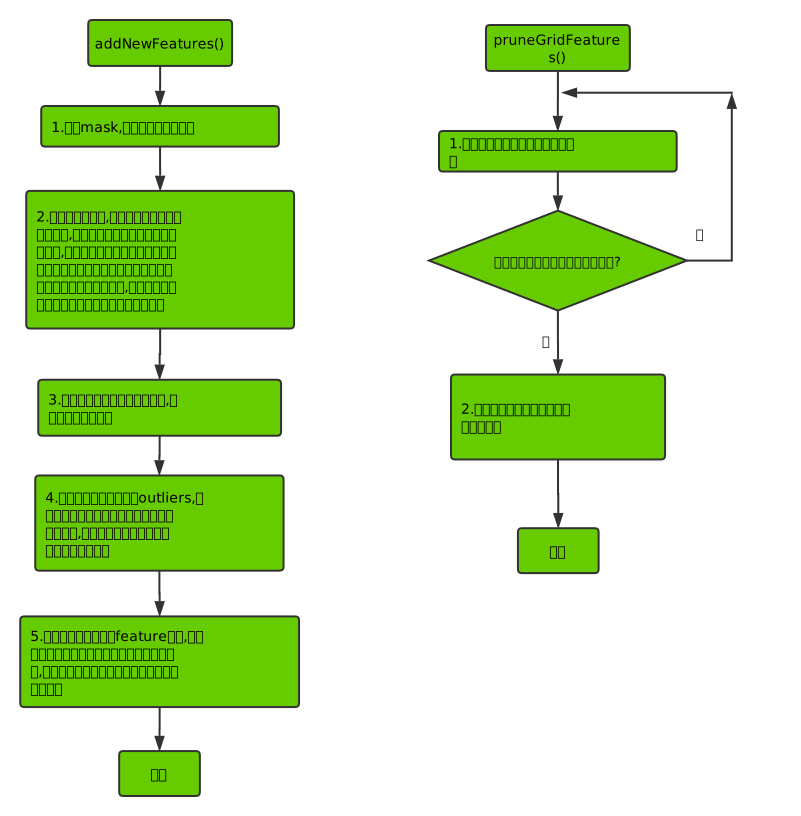
7.3 State Representation

../_images/addNewFeatures&pruneGridFeatures.svg

publish

uint64 id
# Normalized feature coordinates (with identity intrinsic matrix)
float64 u0 # horizontal coordinate in cam0
float64 v0 # vertical coordinate in cam0
float64 u1 # horizontal coordinate in cam0
float64 v1 # vertical coordinate in cam0

其实前端基本上可以说是非常简单了,也没有太多的trick,最后我们来看一下前端的跟踪效果的动图:
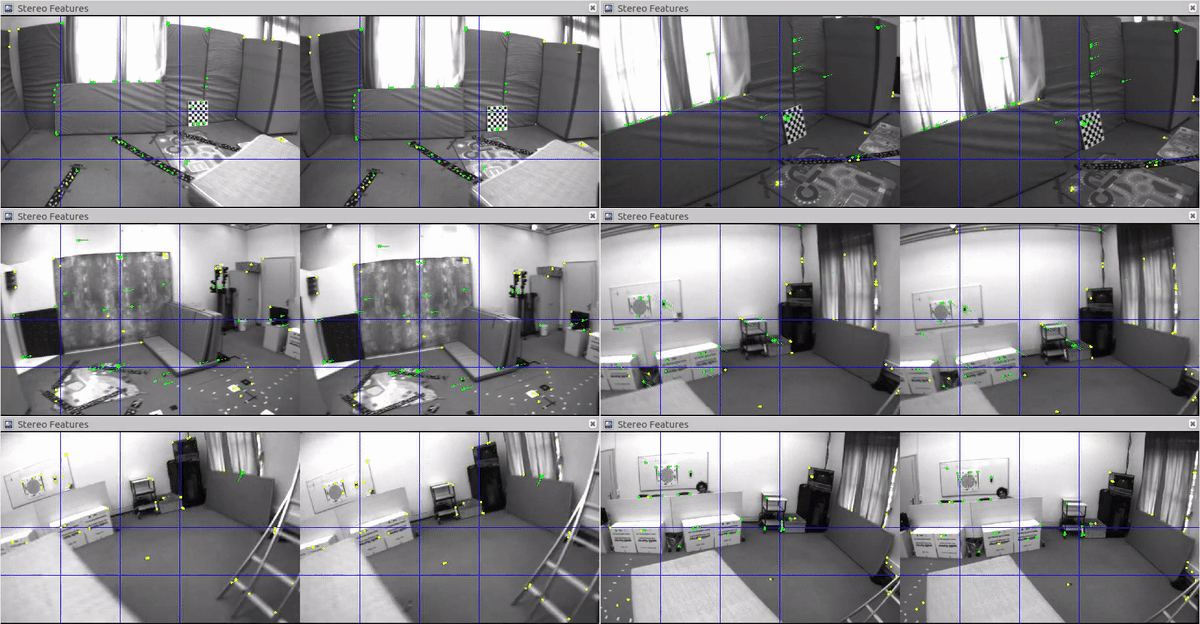
../_images/StereoFeatures.gif

7.4 Propagation

误差状态协方差更新

IMU误差状态方程离散化:

\[\tilde{\mathbf{X}}_{IMU} = \mathbf{F} \tilde{{X}}_{IMU} + \mathbf{G} \mathbf{n}_{IMU}\]

\(t_{k}\)\(t_{k+1}\) 的状态转移矩阵 \(\Phi_{k}\) 和噪声项 \(Q_{k}\) 为:

\[\begin{split}\begin{aligned} \mathbf{\Phi}_{k} &= \mathbf{\Phi}_{k+1} = exp\left( \int_{t_k}^{t_{k+1}} F(\tau)d\tau\right) \\ \mathbf{Q}_{k} &= \int_{t_k}^{t_{k+1}} \mathbf{\Phi}(t_{k+1}, t_k) G QG^T \mathbf{\Phi}(t_{k+1}, t_k)^Td\tau\ \end{aligned}\end{split}\]

其中:

  • \(Q = \mathbf{n_I n_I^{T}}\)

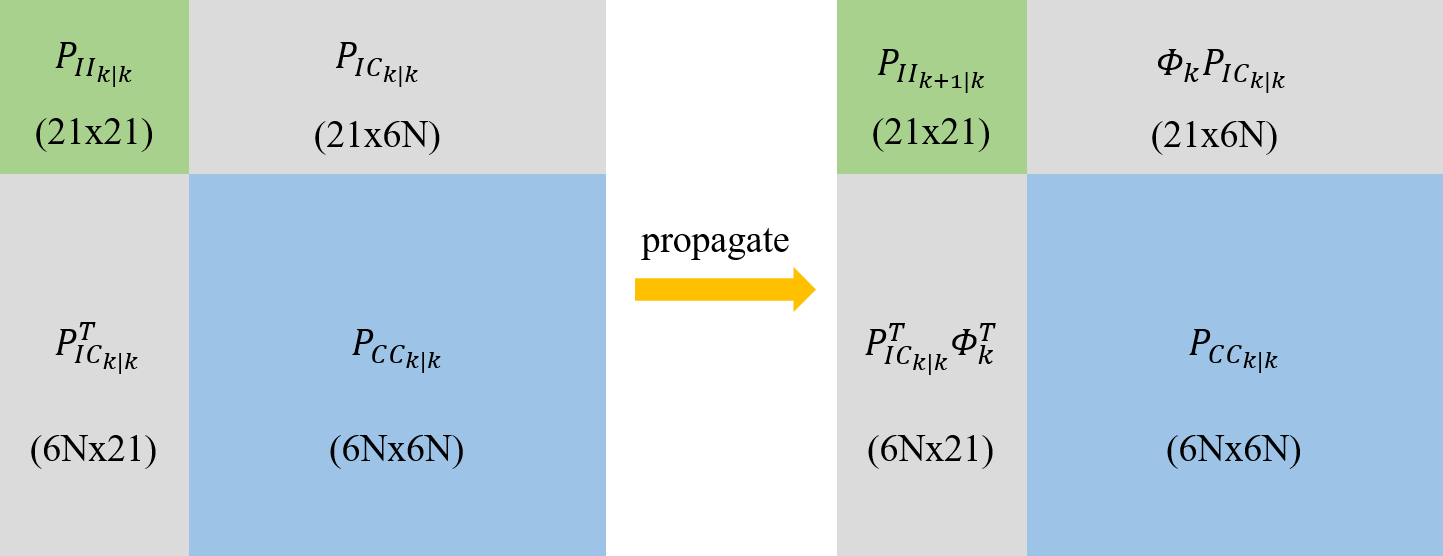
\(k\) 时刻 \(\mathbf{X}_{IMU}\) 变化对系统误差状态协方差矩阵 \(P_{k|k}\) , 系统误差状态协方差矩阵为:

\[\begin{split}\mathbf{P}_{k|k} = \begin{bmatrix} P_{II_{k|k}} & P_{IC_{k|k}} \\ P_{IC_{k|k}}^{T} & P_{CC_{k|k}} \end{bmatrix}\end{split}\]

\(k+1\) 时刻预测的IMU误差状态协方差矩阵为

\[P_{II_{k|k}} = \Phi_{k}P_{II} \Phi_{k}^T + Q_{k}\]

\(k+1\) 时刻预测的系统误差状态协方差矩阵为:

\[\begin{split}\mathbf{P}_{k+1|k} = \begin{bmatrix} P_{II_{k+1|k}} & \Phi_{k} P_{IC_{k|k}} \\ P_{IC_{k|k}}^{T} \Phi_{k}^T & P_{CC_{k|k}} \end{bmatrix}\end{split}\]

整个状态(IMU+Camera)的covariance传播过程如图所示:

../_images/imu_propagate.png

7.5 Augmentation

MSCKF系统的误差状态向量

\[\mathbf{X}_{k} = \begin{bmatrix} \mathbf{x}_{I_{k}}^{T}, \mathbf{\delta \theta}_{C_{1}}^{T}, _G\mathbf{p}_{C_{1}}^{T} \dots, \mathbf{\delta \theta}_{C_{N}}^{T}, _G\mathbf{p}_{C_{N}}^{T} \end{bmatrix}\]

它包括 \(IMU\) 误差状态与 \(N\) 个相机状态。在没有图像进来时,对 \(IMU\) 状态进行预测, 并计算系统误差状态协方差矩阵;在有图像进来时,根据相机与 \(IMU\) 的相对外参计算当前相机的位姿。 然后将最新的相机状态加入到系统状态向量中去,然后扩增误差状态协方差矩阵。

状态向量扩增

根据预测的IMU位姿和相机与IMU的相对外参计算当前相机位姿:

\[\begin{split}\begin{aligned} _G^{C}\hat{q} &= _I^{C} \hat{q} \otimes _G^{I}\hat{q} \\ ^{G} \hat{p}_{C} &= ^{G} \hat{p}_{I} + C(_I^{C} \hat{q})^T (^{I}\hat{p}_C) \end{aligned}\end{split}\]

然后将当前相机状态 \(_G^{C}\hat{q}, ^{G} \hat{p}_{C}\) 加入到状态向量。

  • \(_G^{C}\hat{q}\) : 相机的方向

  • \(^{G} \hat{p}_{C}\): 相机的位置

误差状态协方差矩阵扩增

系统新误差状态 \(X_{new}\) 与系统原误差状态 \(X_{old}\) 的关系为:

\[X_{new} = \frac{\partial{X_{new}}}{\partial{X_{old} }} + C_{0}\]

其中

\[\begin{split}\frac{\partial{X_{new}}}{\partial{X_{old} }} = \begin{bmatrix} \mathbf{I}_{6N+21} \\ \mathbf{J} \end{bmatrix}\end{split}\]

\(J\) 是新增相机误差状态对原系统误差状态的Jacobian:

\[\begin{split}\mathbf{J} = \begin{bmatrix} \frac{\partial{_G^{C_{new}} \delta\theta}}{\partial{\mathbf{x}_{I}}}_{3 \times 21} & \frac{\partial{_G^{C_{new}} \delta\theta}}{\partial{\mathbf{x}_{C}}}_{3 \times 6N} \\ \frac{\partial{^G p_{C_{new}}}}{\partial{\mathbf{x}_{I}}}_{3 \times 21} & \frac{\partial{^G p_{C_{new}}}}{\partial{\mathbf{x}_{C}}}_{3 \times 6N} \end{bmatrix}_{6 \times (21 + 6N)}\end{split}\]

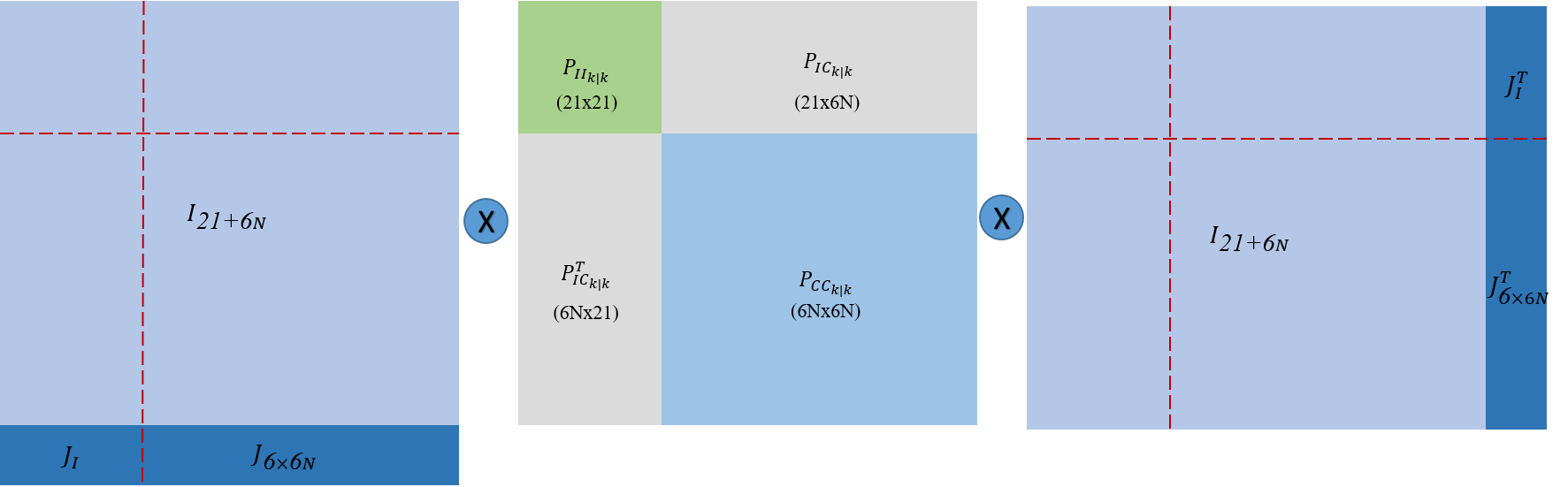
假设上一时刻共有N个相机姿态在状态向量中,那么当新一帧图像到来时,这个时候整个滤波器的状态变成了 \(21 + 6(N+1)\) 的向量, 那么它对应的covariance维度为 \((21 + 6(N+1)) \times (21 + 6(N+1))\) 。求出 \(J\) 后,误差状态协方差矩阵扩增为:

\[\begin{split}P_{k|k} \leftarrow \begin{bmatrix} \mathbf{I}_{6N + 21} \\ \mathbf{J} \end{bmatrix} P_{k|k} \begin{bmatrix} \mathbf{I}_{6N + 21} \\ \mathbf{J} \end{bmatrix}^T = \begin{bmatrix} P_{k|k} & P_{k|k} \mathbf{J}^T \\ \mathbf{J} P_{k|k} & \mathbf{J} P_{k|k} \mathbf{J}^T \end{bmatrix}_{[6(N+1)+21] \times [6(N+1)+21]}\end{split}\]

这个过程对应如下图过程:

../_images/covariance_augmentation.png

7.6 Update Step

MSCKF的观测模型是以特征点为分组的,我们可以知道一个特征(之前一直处于跟踪成功状态)会拥有多个Camera State. 所有这些对于同一个3D点的Camera State都会去约束观测模型. 那这样其实隐式的将特征点位置从状态向量中移除, 取而代之的便是Camera State. 我们考虑单个feture \(f_j\) ,假设它所对应到 \(M_j\) 个相机姿态 \([{}_G^{C_{i}}\mathbf{q}, {}^G \mathbf{p}_{C_i}]^T, i \in j\) 。 当然双目版本的包含左目和右目两个相机姿态, \([{}_G^{C_{i,1}}\mathbf{q}, {}^G \mathbf{p}_{C_i, 1}]^T\)\([{}_G^{C_{i,2}}\mathbf{q}, {}^G \mathbf{p}_{C_i, 2}]^T\) 右相机很容易能通过外参得到. 其中双目的观测值可以表示如下:

\[\begin{split}\mathbf{z}_{i}^{j} = \begin{bmatrix} u_{i, 1}^{j} \\ v_{i, 1}^{j} \\ u_{i, 2}^{j} \\ v_{i, 2}^{j} \\ \end{bmatrix} = \begin{bmatrix} \frac{1}{{}^{C_{i,1}}Z_j} & \mathbf{0}_{2 \times 2} \\ \mathbf{0}_{2 \times 2} & \frac{1}{{}^{C_{i,2}}Z_j} \end{bmatrix} \begin{bmatrix} \frac{1}{{}^{C_{i,1}}X_j} \\ \frac{1}{{}^{C_{i,1}}Y_j} \\ \frac{1}{{}^{C_{i,2}}X_j} \\ \frac{1}{{}^{C_{i,2}}Y_j} \end{bmatrix}\end{split}\]

而特征点在两个相机坐标系下可以分别表示为:

\[\begin{split}\begin{aligned} {}^{C_{i,1}}\mathbf{p} &= \begin{bmatrix} {}^{C_{i,1}}\mathbf{X}_j \\ {}^{C_{i,1}}\mathbf{Y}_j \\ {}^{C_{i,1}}\mathbf{Z}_j \end{bmatrix} = C({}_G^{C_{i,1}}\mathbf{q)}({}^{G}\mathbf{p}_j - {}^{G}\mathbf{p}_{C_{i, 1}}) \\ {}^{C_{i,2}}\mathbf{p} &= \begin{bmatrix} {}^{C_{i,2}}\mathbf{X}_j \\ {}^{C_{i,2}}\mathbf{Y}_j \\ {}^{C_{i,2}}\mathbf{Z}_j \end{bmatrix} = C({}_G^{C_{i,2}}\mathbf{q)}({}^{G}\mathbf{p}_j - {}^{G}\mathbf{p}_{C_{i, 2}}) \\ &= C({}_{C_{i,1}}^{C_{i,2}}\mathbf{q)}({}^{C_{i,1}}\mathbf{p}_j - {}^{C_{i,1}}\mathbf{p}_{C_{i, 2}}) \end{aligned}\end{split}\]

其中 \({}^{G}\mathbf{p}_j\) 是特征点在惯性系下的坐标,这个是通过这个特征点的对应的所有camera state三角化得到的结果. 将观测模型在当前状态线性化可以得到如下式子:

\[\begin{split}\begin{aligned} \mathbf{r}^{j}_{i} &= \mathbf{z}^{j}_{i} - \mathbf{\hat{z}}^{j}_{i}\\ &=\mathbf{H}_{C_{i}}^{j} \mathbf{x} + {\color{Red}{\mathbf{H}^{f_j w} \mathbf{p}_{j}}}+ \mathbf{n}^{j}_{i} \end{aligned}\end{split}\]

其中 \(\mathbf{n}^{j}_{i}\) 是观测噪声, \(\mathbf{H}_{C_{i}}^{j}\)\(\mathbf{H}^{f_j w}\) 是对应的雅克比矩阵。 对应到的是单个特征点对应的其中某一个相机姿态, 但是这个特征点会对应到很多相机姿态。

\[\begin{split}\begin{aligned} \mathbf{r}^{j}_{o} &= \mathbf{V}^{T}( \mathbf{z}^{j} - \mathbf{\hat{z}}^{j}) \\ &= \mathbf{V}^{T}\mathbf{H}^{j} \mathbf{x} + \mathbf{V}^{T}\mathbf{H}^{f_j w} \mathbf{p}_{j} + \mathbf{V}^{T} \mathbf{n}^{j} \\ &= \mathbf{V}^{T}\mathbf{H}^{j} \mathbf{x} + \mathbf{V}^{T} \mathbf{n}^{j} \\ &= \mathbf{H}^{j}_{0} \mathbf{x} + \mathbf{n}^{j}_{o} \end{aligned}\end{split}\]

但是这个其实并不是一个标准的EKF观测模型,因为我们知道 \(\mathbf{\tilde{p}_j}\) 并不在我们的状态向量里边, 所以做法是将式子中红色部分投影到零空间, 假设 \(\mathbf{H^{f_{j}w}}\) 的left null space为 \(\mathbf{V}^T\) , 即有 \(\mathbf{V}^T \mathbf{H^{f_{j}w}} = 0\), 所以:

\[\mathbf{r}^{j}_{o} = \mathbf{H}^{j}_{0} \mathbf{x} + \mathbf{n}^{j}_{o}\]

这样就是一个标准的EKF观测模型了,下面简单分析一下维度.分析时针对单个特征点, 我们知道 \(\mathbf{H^{f_{j}w}}\) 的维度是 \({4M_j} \times 3\) , 那么它的left null space的维度即 \(\mathbf{V}^T$的维度为$(4M_j -3) \times 4M_j\) , 则最终 \(\mathbf{H}^{j}_{0} \mathbf{x}\) 的维度变为 \((4M_j-3) \times 6\) , 残差的维度变为 \((4M_j-3) \times 1\) , 假设一共有L个特征的话,那最终残差的维度会是 \(L (4M_j-3) \times 6\).

7.7 Post EKF Update

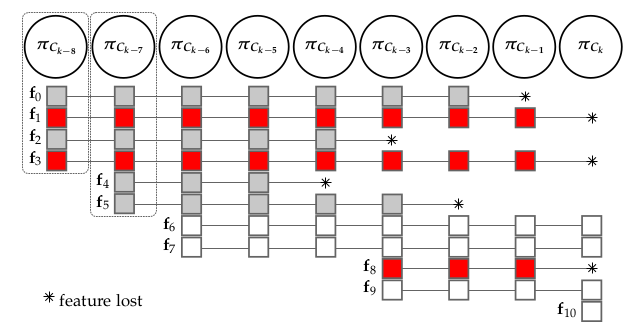
大致是有两种更新策略,假设新进来一帧图像,这个时候会丢失一些特征点,这个时候丢失的特征点(且三角化成功)用于滤波器更新,如下图所示:
../_images/post_ekf_update.png

8 参考文献